What Is AI Orchestration? A Clear Explanation
Orchestration is the coordination layer that turns model capability into a controlled, multi-step system, the part that decides which tool runs, what state is kept, what gets checked, and when a human takes over.
7 min readby Prithvi

Introduction
AI orchestration is the coordination layer that turns model capability into a controlled, multi-step system.
A language model can interpret instructions and generate a response, but it does not automatically know which tools to call, in what order, how to preserve state, how to check an outcome, or when a human should take over. Those responsibilities belong to the surrounding system that orchestrates the model, context, tools, policies, and results.
This is why orchestration is becoming central to enterprise AI. The more an AI system is expected to do—retrieve information, use several tools, recover from errors, and complete a task over multiple steps—the less adequate a single prompt-and-response pattern becomes.
What does AI orchestration mean?
AI orchestration is the management of the steps, resources, and controls required for an AI system to complete a task.
Depending on the implementation, orchestration may involve:
- Interpreting the user’s goal.
- Selecting a model or capability.
- Retrieving relevant context.
- Choosing and calling tools.
- Passing the tool results back to the model.
- Maintaining task state.
- Validating intermediate and final results.
- Handling retries and failures.
- Enforcing permissions and policies.
- Requesting human approval.
- Escalating when the system cannot proceed.
- Recording what happened for evaluation and audit.
Orchestration is therefore broader than routing a request between models. It governs how an AI system behaves over time and across actions.
AI orchestration versus workflow automation
Traditional workflow automation follows a predefined sequence. If condition A occurs, perform action B, then action C. This is effective when the process is stable and the rules are known in advance.
AI orchestration is useful when the system must interpret a goal, determine the next step, select among available tools, and adapt when the environment changes.
The distinction should not be overstated. AI orchestration often uses conventional workflow components, and many reliable systems combine fixed rules with model-based decisions. A rule may determine whether an action is allowed, while the model determines which approved information source to consult next.
The strongest architecture uses deterministic controls where determinism is valuable and model-based reasoning where flexibility is needed.
AI orchestration versus an AI agent
An AI agent is an application or system that pursues a goal using reasoning and action. AI orchestration is the mechanism that coordinates the agent’s loop.
An agent may decide that it needs to find a customer record, compare it with a policy, draft a response, and request approval. Orchestration manages the execution of those steps: it supplies context, calls the relevant tools, preserves state, checks results, and enforces the conditions under which the agent may continue.
In simple systems, orchestration may be minimal. In enterprise systems, it becomes a major part of the product because reliability depends on more than the model’s initial response.
The AI orchestration loop
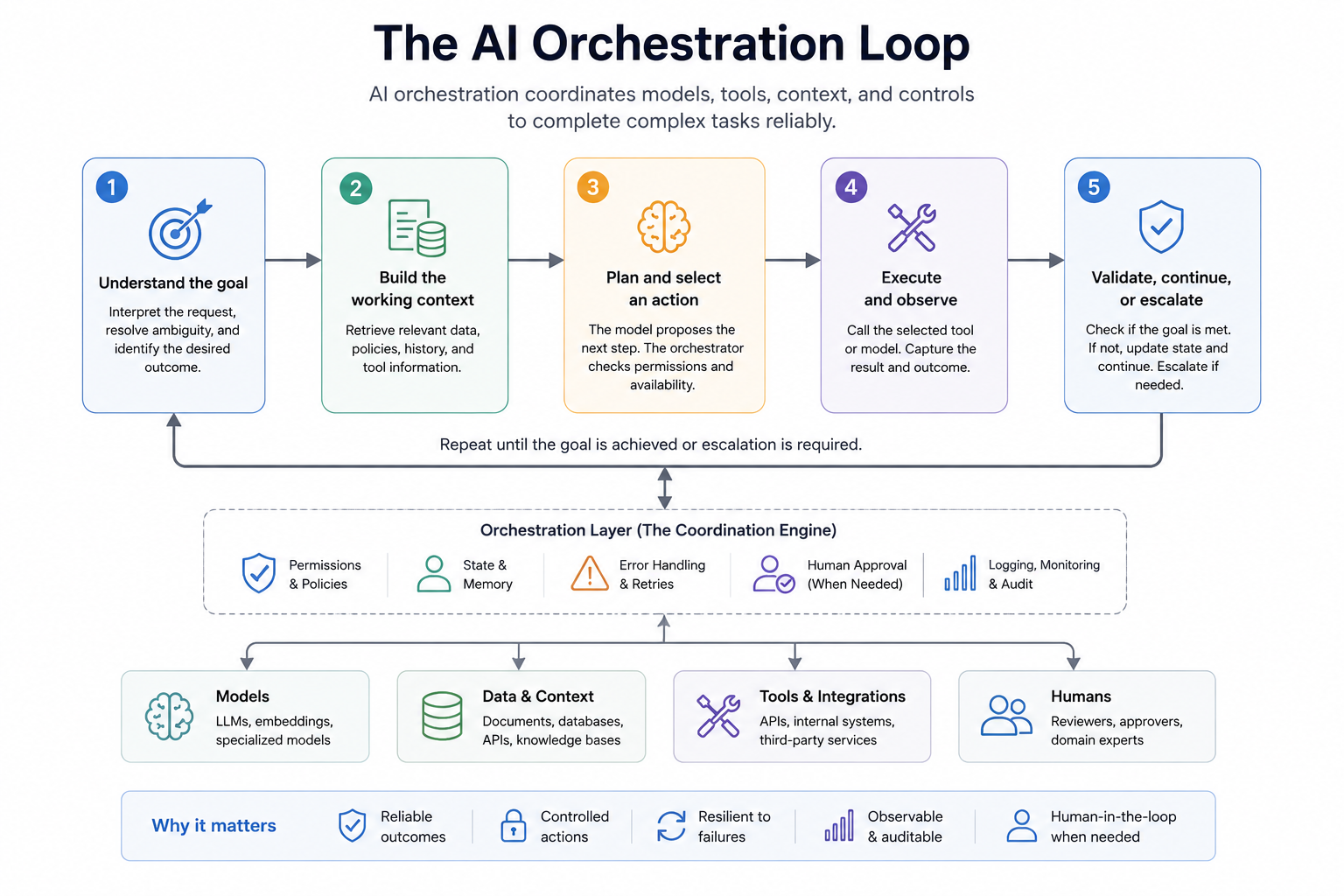
A useful orchestration loop has five stages.
1. Understand the goal
The system interprets the request and identifies the desired outcome. It may need to resolve ambiguity, confirm required inputs, or classify the task before proceeding.
2. Build the working context
The system retrieves the documents, records, policies, task history, and tool descriptions relevant to the goal. Context should be selected rather than indiscriminately appended.
3. Plan and select an action
The model proposes the next step. The orchestrator checks whether that step is permitted and whether the required tool and inputs are available.
4. Execute and observe
The selected tool is called, and the result is returned to the system. The result may confirm the plan, introduce new information, or reveal an error.
5. Validate, continue, or escalate
The system checks whether the task is complete. If not, it updates the state and continues. If the result is unsafe, ambiguous, or outside the agent’s authority, the orchestrator pauses and escalates.
This loop may run once or many times. The key point is that the system does not treat every model response as the final answer.
Why orchestration matters for enterprise AI
Reliability
A model can produce a plausible answer even when it used the wrong source or misunderstood the task. Orchestration creates opportunities to validate the result, check required fields, compare outputs, and enforce completion criteria.
Control
Tools give agents the ability to affect external systems. Orchestration provides a place to enforce permissions, approval gates, rate limits, and action-specific policies.
Resilience
Tools fail. Data can be missing. Services can time out. A production system needs to decide whether to retry, use an alternative path, ask for clarification, or stop. These decisions should not be left entirely to an unconstrained model.
Observability
Teams need to know what the system did, which context it used, which tools it called, and where it encountered uncertainty. This makes debugging and improvement possible.
Cost and performance
Orchestration can determine when to use a smaller model, when to retrieve additional context, when to stop, and when a task has exceeded its limits. Good coordination can improve both performance and cost discipline.
Common orchestration patterns
Sequential orchestration
The system completes a series of dependent steps. The output of one step becomes the input to the next. This pattern is useful when the process has a logical order but still benefits from model-based interpretation within individual steps.
Router orchestration
The system classifies a request and sends it to the most appropriate agent, model, workflow, or tool. Routing can reduce unnecessary complexity, but the routing rules should be evaluated carefully because a wrong initial classification can send the task down the wrong path.
Planner-and-executor orchestration
One component creates a plan while another executes and reports the result. The plan may be revised after each observation. This pattern is useful for tasks whose steps cannot be fully known in advance.
Human-in-the-loop orchestration
The system pauses for approval at defined points. This is appropriate when actions are consequential, information is incomplete, or the organization wants a person to review the result before it leaves the system.
Event-driven orchestration
An event—such as a new record, document, or request—starts the process. The orchestrator determines what needs to happen next and tracks the task until completion or escalation.
How to design a reliable orchestration layer
Start by defining the state the system must retain. State may include the original request, completed actions, tool results, unresolved questions, approval status, and final output requirements.
Next, define tool contracts. Each tool should describe its inputs, outputs, permissions, failure modes, and side effects. The orchestrator can then prevent the agent from calling a tool with incomplete or invalid parameters.
Add explicit stopping rules. These may include success criteria, maximum steps, time limits, retry limits, and escalation conditions.
Finally, design for inspection. A person responsible for the system should be able to understand what happened without reconstructing the entire process from a final answer.
Where Libra fits
Libra is relevant to AI orchestration because its positioning is centered on self-deployable AI agents that can operate while teams retain control of the systems and data those agents use.
That control question is inseparable from orchestration. When an agent can access organizational knowledge or act through business systems, the organization needs more than a model response. It needs a defined operating boundary around the agent: where it runs, what it can access, what actions it can take, and when it must defer to a human.
The connection is therefore architectural. Libra is an environment for deploying autonomous agents within an organization’s chosen control model, rather than a black-box assistant that simply generates text. What makes that concrete is the relationship between agent goals, connected systems, permissions, task state, review points, and completion.
AI orchestration best practices
Use models for interpretation and adaptation, but use deterministic controls for permissions, validation, and high-impact actions.
Keep context relevant and traceable. The system should be able to identify which sources informed a decision where that matters.
Treat failures as normal operating conditions. Define retries, alternatives, timeouts, and escalation paths before deployment.
Start with approval gates for consequential actions. Increase autonomy only after the agent performs reliably on representative tasks.
Evaluate the complete system, not just the model. A strong model can still be embedded in a weak orchestration design.
Conclusion
AI orchestration is the discipline of coordinating models, context, tools, state, policies, validation, and human oversight so an AI system can complete useful work reliably.
It is what separates a single response from a multi-step capability. It gives the system a way to act, observe, recover, and stop. For enterprise AI, that coordination layer is not an implementation detail. It is where much of the practical control and reliability of the system is established.
Libra’s self-deployable agent platform positioning offers a natural connection to this problem: teams can pursue autonomous capability while retaining control over the systems and data their agents operate on. The value of that approach is clearest when the agent is treated as an operational system—not merely as a prompt wrapped around a model.