What Are AI Agents? A Plain-English Explanation
An AI agent takes a goal, decides what steps to take, uses tools, and checks whether it worked. Learn what agents are made of, how they work, where they succeed and fail, and what to consider before deploying one.
7 min readby Prithvi

The one distinction that matters
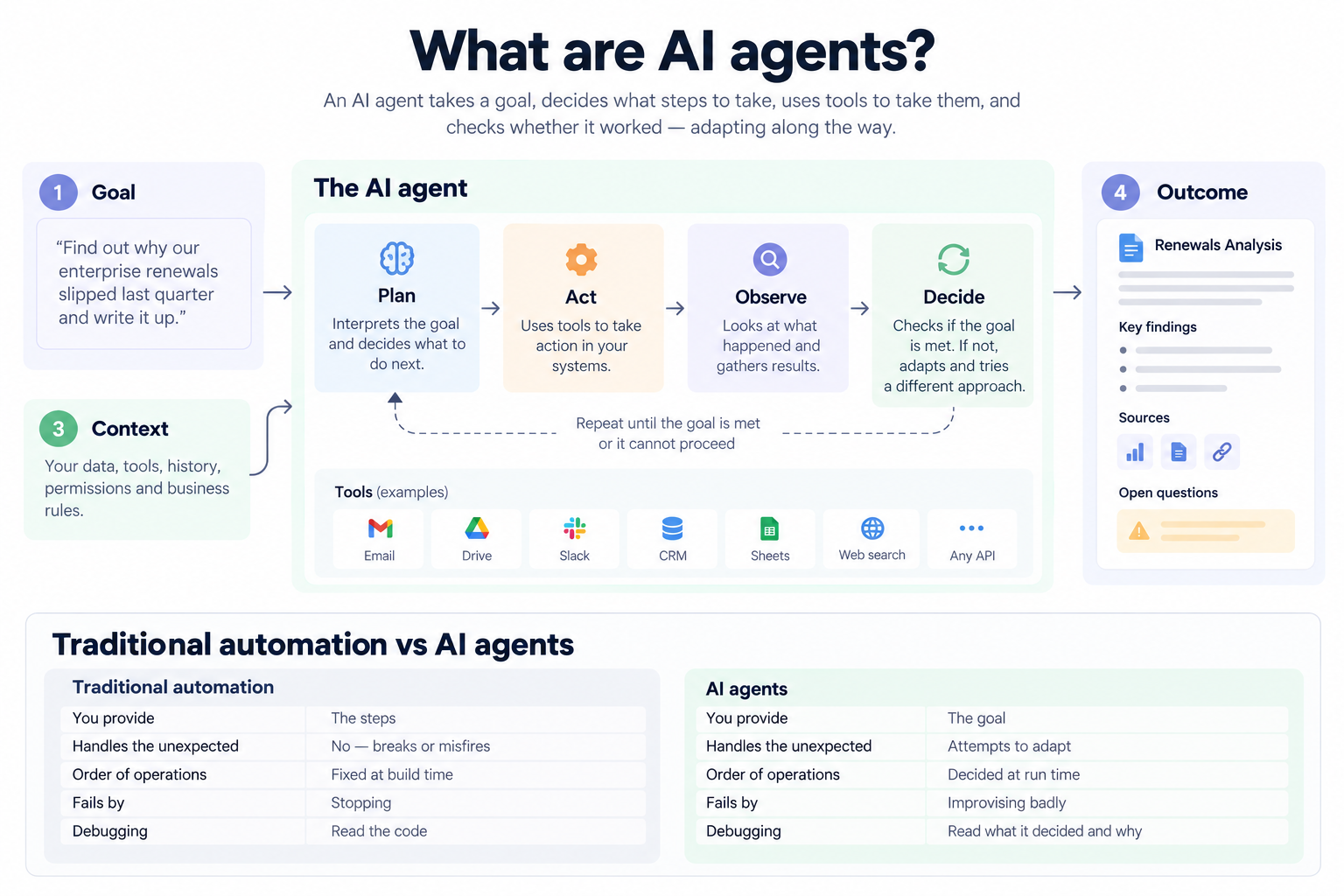
An AI agent is a software system that takes a goal, decides what steps to take, uses tools to take them, and checks whether it worked. That last part — deciding the steps rather than following steps somebody wrote in advance — is the whole difference between an agent and every piece of automation that came before it.
Everything else in this article is elaboration on that sentence.
Traditional software does what it was told. You write the steps, the program follows them, and if reality differs from what you anticipated, the program breaks or does the wrong thing confidently.
An agent is given an objective instead of a procedure. It works out the procedure at runtime, adapts when a step fails, and stops when the objective is met or when it cannot proceed.
| Traditional automation | AI agent | |
|---|---|---|
| You provide | The steps | The goal |
| Handles the unexpected | No breaks or misfires | Attempts to adapt |
| Order of operations | Fixed at build time | Decided at run time |
| Fails by | Stopping | Improvising badly |
| Debugging | Read the code | Read what it decided and why |
That last row is the one people underestimate. Traditional automation fails loudly and in a known place. Agents fail creatively, which is harder to anticipate and much harder to test.
What an agent is made of
Strip away the marketing and every agent has four parts.
A model. The reasoning engine — a large language model that interprets the goal, plans, and decides what to do next. This is the part everyone thinks of as "the AI," and it is roughly a quarter of the system.
Tools. The things it can actually do. Search a database, send an email, call an API, update a record, read a file. An agent with no tools is a chatbot; the tools are what let it change something in the world. This is also where most of the engineering work lives.
Context. What it knows about your situation — your documents, your systems, your history, who you are and what you are allowed to see. A model with no context gives generic answers. A model with good context gives answers specific to your company, which is the entire commercial value.
A loop. The part that makes it an agent rather than a single response. The agent acts, observes what happened, decides whether the goal is met, and either continues or stops. The loop is why an agent can recover from a failed step instead of returning an error.
Remove any one of these and you have something else. Model plus context but no tools and no loop is retrieval-augmented chat. Model plus tools but no loop is a function call. The loop is the agent.
How it actually runs
A concrete example is more useful than a diagram. Take a request an agent might receive at a software company: "Find out why our enterprise renewals slipped last quarter and write it up."
A traditional report would need someone to define in advance which systems to query and in what order. An agent works differently:
- Interprets the goal. Renewals, enterprise segment, last quarter, causes — and that "wrote it up" means a document, not a chart.
- Plans an approach. Get the renewal data, identify which accounts slipped, look for what those accounts have in common.
- Acts. Queries the CRM for enterprise renewals with closed dates in the period.
- Observes. Eleven accounts slipped. Four have open escalations.
- Re-plans based on what it found. The escalation overlap was not in the original plan. It now pulls those support threads.
- Acts again. Reads the escalations, finds three of the four reference the same integration failure.
- Checks. Does this answer the question? Partly — it explains four of eleven. It looks at the remaining seven.
- Stops and reports, with sources, and flags what it could not explain.
Step 5 is the agentic part. Nobody told it to check support escalations. It found a pattern and followed it, which is what a competent analyst does and what a fixed script cannot.
What agents are good and bad at
The honest version, because the category is oversold.
Genuinely good at:
- Work that spans several systems, where the value is in the joining rather than any single step
- Tasks where the right sequence depends on what earlier steps return
- Research and synthesis across a large corpus
- Repetitive judgement calls with clear criteria — triage, routing, categorisation
- Drafting where a human reviews before anything is committed
Genuinely bad at:
- Anything requiring guaranteed correctness with no review. Agents are probabilistic. They will be wrong sometimes, and confidently
- High-stakes irreversible actions — moving money, deleting data, sending to customers without approval
- Work where a deterministic script already does the job. If the steps never change, an agent adds cost, latency and a new failure mode for nothing
- Tasks needing genuine domain expertise the model does not have and your context does not supply
- Anything where you cannot tolerate the failure mode of being plausibly wrong
The last point deserves weight. An agent that fails by stopping is an inconvenience. An agent that fails by producing a confident, well-formatted, wrong answer is a liability, because it looks exactly like a correct one.
Autonomy is a dial, not a switch
"Autonomous agent" implies a binary. In practice autonomy is a setting you choose per task, and choosing it badly is the most common implementation error.
| Level | The agent | Appropriate when |
|---|---|---|
| Suggest | Proposes, human does it | Stakes are high, trust is new |
| Draft | Produces output, human approves before it lands | Most business use today |
| Act with checkpoint | Executes, pauses at defined points | Multi-step work with one risky step |
| Act and report | Executes fully, reports after | Low stakes, reversible, well-tested |
Most production deployments sit in the middle two, and the ones that fail publicly are almost always organisations that jumped to the bottom row before earning it. The right approach is to start at suggest, measure how often the agent was right, and move down the table as the evidence justifies it.
Where agents get their context
An agent with a good model and no context about your company is an expensive generalist. It can write a decent email and knows nothing about your customers, your pricing, or the decision your team made in March.
Context arrives three ways:
Retrieval. The agent searches your documents and systems and pulls relevant material into its working memory at the moment it needs it. This is the most common pattern and the reason enterprise search and agents keep converging as categories.
Tools. Rather than reading a document about your customers, the agent queries the CRM directly. More current, more precise, and it requires the integration to exist.
Memory. What the agent retains across sessions — preferences, prior decisions, the outcome of things it tried before. The least mature of the three in most products, and the one that matters most for agents that work alongside a team over time.
The quality ceiling of any agent is set by its context, not its model. This is why two companies using the same underlying model get very different results, and why "which model does it use" is a less useful procurement question than it sounds.
What to ask before deploying one
Five questions that separate a working deployment from a demo.
- What exactly can it do? Get the list of tools and the permissions each one holds. "It can access your systems" is not an answer.
- Whose permissions does it use? If the agent runs with broader access than the person asking, it will eventually surface something it should not. Permissions should resolve per user, at query time. See permission-aware AI.
- Can it show its work? Every claim should trace to a source and every action to a log. Systems that cannot show this cannot be debugged or defended.
- What happens when it is wrong? Not if. Ask about review points, rollback, and how errors surface. See AI agent security for the risks worth taking seriously.
- How do you measure it? If nobody can say what "working" means numerically, the deployment will be judged on vibes and quietly abandoned.
Where Libra fits
Libra WorkBase runs agents over a company's actual work rather than in isolation from it. The context comes from the systems already in use — documents, meetings, email, tickets — with permissions resolved per user against those source systems, and every answer carrying its sources. Autonomy is configurable per workflow rather than fixed, so a team can start at draft-and-approve and move further as the evidence supports it.
The practical difference from a general-purpose assistant is the context layer: an agent that knows what your company decided and why tends to be more useful than one that knows the internet.