Agentic AI vs AI Agents: What's Actually Different
Agentic AI and AI agents aren't the same. Learn how they differ, how much agency businesses actually need, and what to consider when deploying AI agents.
6 min readby Prithvi

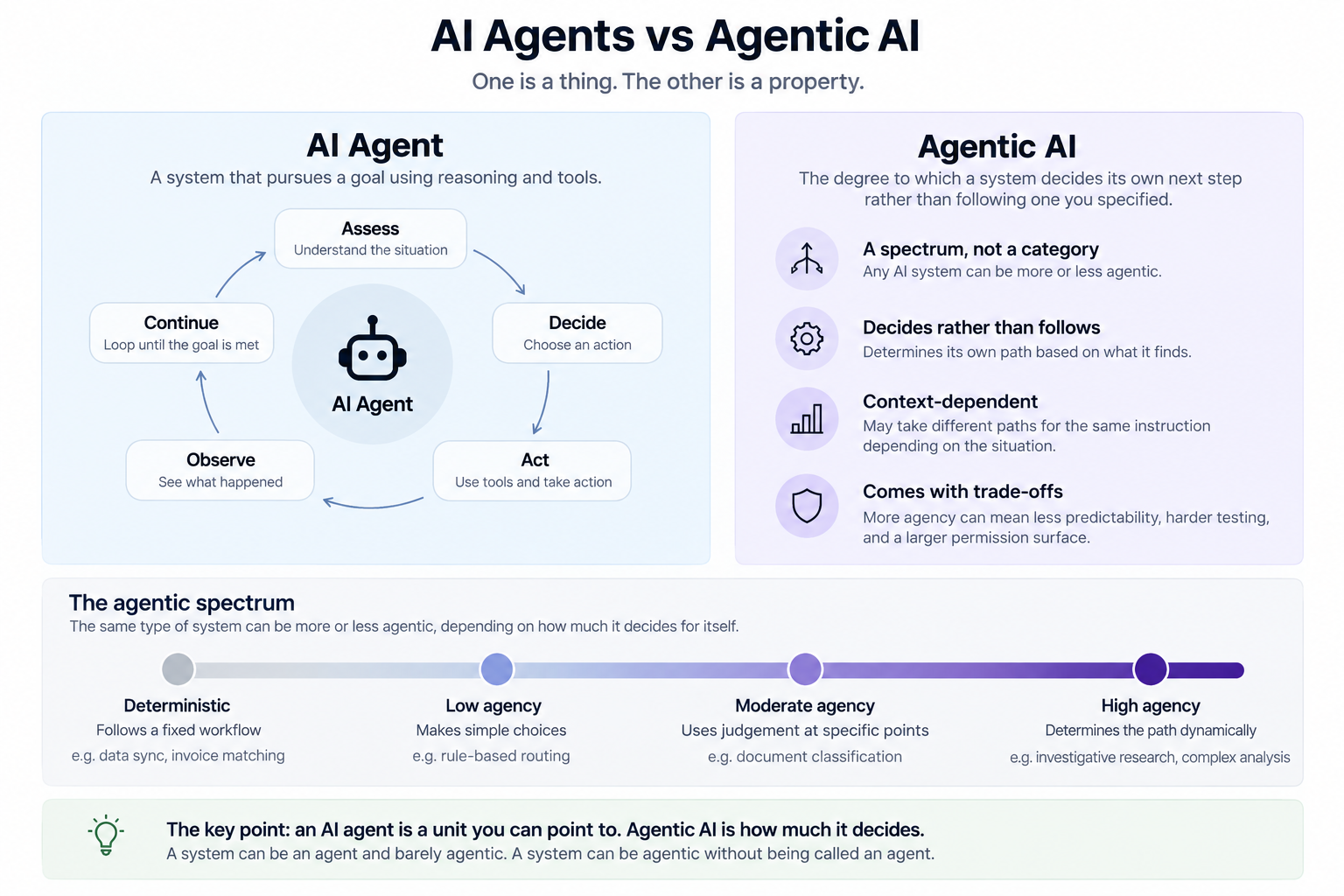
An AI agent is a thing. Agentic AI is a property.
That is the whole distinction, and almost every confused conversation about these two terms comes from treating them as competing product categories rather than as a noun and an adjective.
An AI agent is a system that pursues a goal using reasoning and tools. Agentic AI describes the degree to which any AI system decides its own next step rather than following one you specified.
A system can be an agent and barely agentic. A system can be agentic without anyone calling it an agent.
Understanding which you are buying matters, because the two words appear on the same vendor page describing different amounts of risk.
If you're evaluating what an AI agent can actually do inside a business, see AI Agents for Business: Where They Work and Where They Don't.
The definitions, precisely
An AI agent is a bounded system with a goal, access to tools, and a loop:
Assess → Decide → Act → Observe → Continue
The agent is the unit. You can point at it, name it, give it permissions, and switch it off.
Agentic AI is the characteristic of deciding rather than following.
It is a spectrum, not a category. A system sits somewhere on that spectrum depending on how much of the path from goal to outcome it determines for itself.
The useful test is simple:
If you can draw the flowchart in advance and it will be correct every time, the system is not meaningfully agentic, whatever it is called. If the path depends on what the system finds along the way, it is.
Why the distinction keeps collapsing
Three reasons, all of them commercial.
1. Vendors use the terms interchangeably
"Agentic AI platform" and "AI agent platform" appear on the same site, often on the same page, describing the same product.
There is no industry body enforcing a difference.
2. "Agentic" is doing marketing work
It signals modernity in a way "agent" no longer does, because chatbots were called agents for a decade.
Rebranding is cheaper than rebuilding.
3. The spectrum has no natural cut point
Every system decides something.
A rules engine decides which branch to take. Calling that agentic is defensible and useless.
The word only earns its keep at the point where the system chooses actions its designer did not enumerate.
Where the difference actually shows up
Four places. And they are the four places enterprise deployments go wrong.
Predictability
A non-agentic system does the same thing every time.
An agentic one may take a different path on Tuesday than it did on Monday, given the same instruction, because the context differed.
That is the feature and the risk in one sentence.
Testing
You test a deterministic workflow by running it.
You cannot test an agentic system that way. You have to evaluate it across a distribution of cases, because the specific path is not the thing being tested.
Teams that skip this discover it in production.
Failure modes
A deterministic system fails loudly: the step errors, the process halts.
An agentic system can fail quietly. It takes a plausible wrong path, completes it confidently, and produces something that looks like a result.
Silent failure is harder to catch and more expensive when you don't.
Permissions
A deterministic workflow needs access to the systems its steps touch, and you know those in advance.
An agentic system needs access to the systems it might decide to touch, which is a much larger set.
This is the question most enterprise buyers underweight until security asks it.
For enterprise teams, this makes the underlying architecture just as important as the agent itself. Libra's AI Agents are designed to work against the systems and permissions a team already uses, with approval controls around actions.
How much agency does a given task need?
More is not better.
Agency is a cost you pay for handling variance.
None
The process is stable, the inputs are structured, and the steps are the same every time.
Examples:
- Invoice matching
- Data syncing
- Form routing
Use deterministic automation. It is cheaper, faster, and auditable.
Some
The process is stable but the inputs are messy.
Examples:
- Classifying inbound requests
- Extracting terms from contracts that follow no template
- Summarising conversations
The system needs judgement at specific points and nowhere else.
Bound the agency to those points.
Substantial
The goal is stable but the path genuinely varies.
For example:
"Find out why this account's usage dropped."
That cannot be fully flowcharted, because the answer determines the next question.
This is where agentic systems earn their cost — and where evaluation, observability, and permission design stop being optional.
The common failure is buying substantial agency for a problem in the first category, then being surprised when an unpredictable system solves a predictable problem inconsistently.
What to ask a vendor
Skip "Is it agentic?"
Everyone says yes.
Ask these instead:
"Show me a task where it chooses a different path depending on what it finds."
If they can't demonstrate one, the agency may be mostly marketing.
"What happens when it picks the wrong path?"
You are listening for detection and recovery, not for a claim that it doesn't happen.
"What can it reach that I haven't explicitly authorised?"
The honest answer is a list, not a reassurance.
"How do you evaluate it?"
A vendor running agentic systems in production should have an evaluation methodology.
If they don't, they may be shipping something they cannot properly measure.
For a broader framework, see Enterprise AI Platforms: 2026 Buyer's Guide.
Where Libra sits
Libra AI Agents are agentic within bounds that you set.
The agency is in how a task gets done — which sources to consult, which order to work in, and when to stop and ask.
The bounds are the permissions each person already has in the underlying systems, resolved at the moment of action rather than copied into an index.
That combination is deliberate.
Unbounded agency is a security problem. Bounded determinism is a capability ceiling.
The useful position is agency inside a boundary someone chose on purpose.
For example, a sales agent might pull context from email, CRM records, meetings, and other connected systems before preparing a follow-up. A product agent might connect decisions in Slack to tickets and specs in Jira, Linear, or Notion.
See how this works in practice with Libra WorkBase for Sales or Libra WorkBase for Engineering & Product.
The same principle applies to marketing workflows, where agents can work across briefs, campaign context, research, and existing work. See Libra WorkBase for Marketing.
Frequently asked questions
Is agentic AI just a rebrand of AI agents?
Partly.
The underlying technology overlaps heavily, and some vendors did simply relabel. But the distinction is real: "agent" names the system, while "agentic" describes how much it decides.
A rules-based chatbot was called an agent for years and was not agentic in any meaningful sense.
Can you have agentic AI without agents?
Yes.
Any system that determines its own steps is agentic whether or not it is packaged as a discrete agent.
For example, a search system that decides to run three follow-up queries before answering is behaving agentically.
Is more agency always better?
No.
Agency buys you the ability to handle variance, and costs you predictability, testability, and a larger permission surface.
If the process doesn't vary, you are paying for something you don't need.
How is this different from autonomous AI agents?
"Autonomous" usually describes agency plus the absence of a human checkpoint.
An agent can be highly agentic and still stop for approval at each meaningful step.
For a deeper look at autonomy, read Autonomous AI Agents: How They Work, Architecture, and Enterprise Use Cases.