Enterprise Search vs RAG vs AI Agents vs Company Brain
Enterprise search, RAG, AI agents, and a company brain solve different problems. Learn how they fit together and which layer your enterprise AI needs.
7 min readby Prithvi

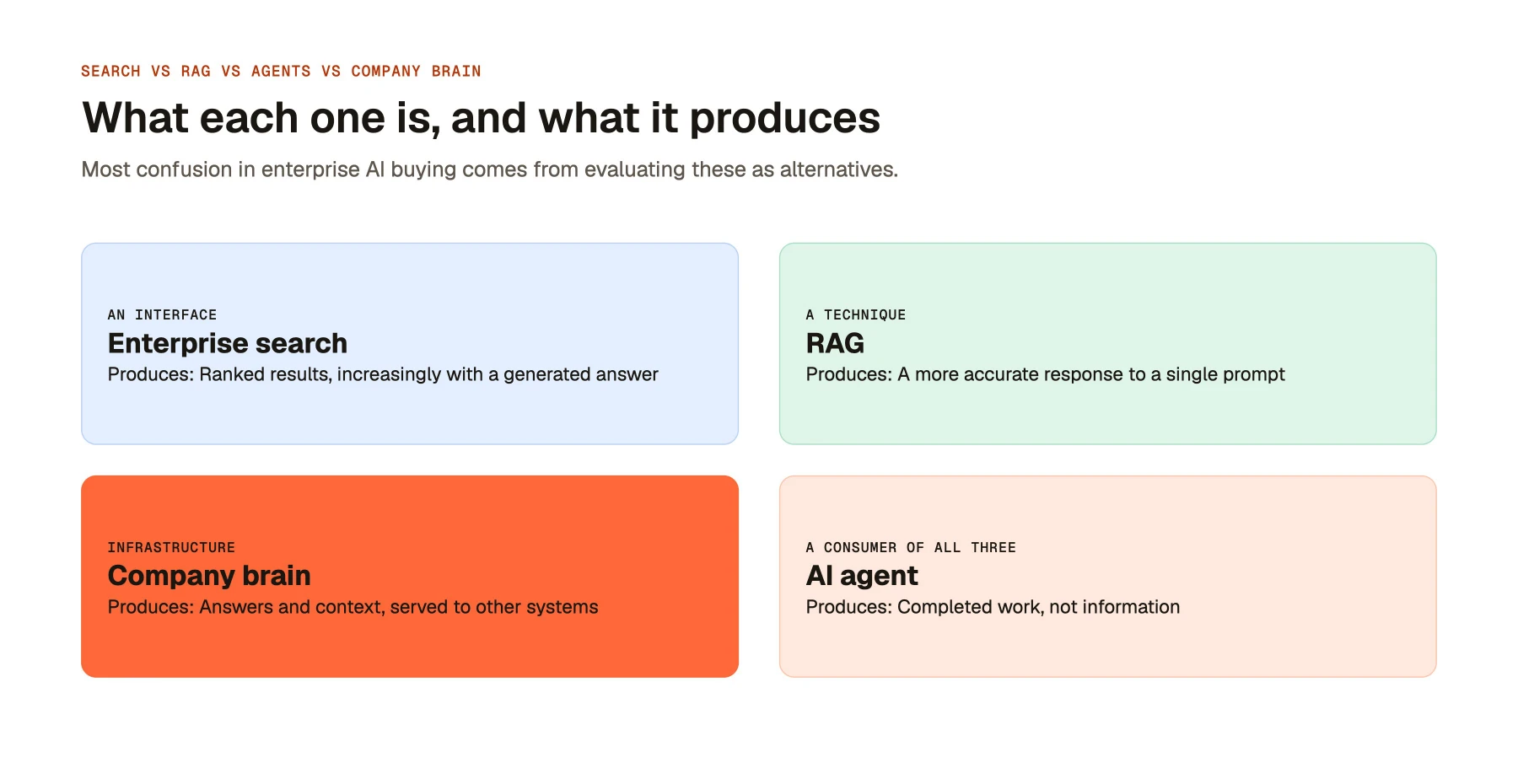
Enterprise search is an interface. RAG is a technique. A company's brain is infrastructure. An AI agent is a consumer of all three.
Most confusion in enterprise AI buying comes from evaluating them as alternatives when they actually sit on top of one another.
That can lead to buying two things that do the same job or buying one thing that only solves a third of the problem.
This guide defines each layer, shows how they fit together, and gives you a simple way to work out which layer your actual problem lives at.
Enterprise Search vs RAG vs AI Agents vs Company Brain: Quick Definitions
| Term | What it is | What it produces |
|---|---|---|
| Enterprise Search | An interface for finding information across a company's systems | Ranked results, increasingly with a generated answer |
| RAG | A technique for grounding a model's output in retrieved documents | A more accurate response to a single prompt |
| Company Brain | A persistent, permission-aware layer of organisational knowledge | Answers and context served to other systems |
| AI Agent | Software that plans and executes multi-step tasks | Completed work, not information |
The single most useful sentence for keeping them straight:
RAG is how enterprise search is where a person asks, a company brain is what gets asked, and an agent is who else is asking.
What Is Enterprise Search?
Enterprise search indexes content across a company's systems and returns relevant results for a query.
It has existed for two decades, Autonomy, Coveo, Elastic and the modern generation adds semantic understanding and generated answers on top of retrieval.
What defines enterprise search?
It serves a person through a search interface, and the output is information.
What does enterprise search do well?
Enterprise search is good at finding documents across a fragmented estate, with permissions respected, at scale.
Where does enterprise search stop?
At the answer.
Classic enterprise search does not act, does not persist context across sessions, and does not serve other software.
Newer platforms have extended into agents, which is precisely why the category boundaries have blurred.
What Is RAG?
RAG, or retrieval-augmented generation, is a technique not a product. That distinction matters because RAG is regularly sold as though it were a product category.
The basic mechanism is straightforward: Rather than relying only on what a model learned during training, the system retrieves relevant documents at query time and passes them into the model's context.
The answer is therefore grounded in specific source material rather than being generated solely from general training data.
What defines RAG?
It operates per query. Documents are retrieved, used, and then discarded when the response is generated.
What does RAG do well?
RAG is one of the key techniques that makes enterprise AI possible. It grounds output in current, company-specific information and can provide citations back to source material.
Where does RAG stop?
RAG has no memory of what it retrieved last time and no opinion about what should be retrievable. Both of those are properties of the layer underneath it. So when a vendor says "we use RAG," that answers a question about method, not architecture.
What is Agentic RAG?
Agentic RAG is a newer variant where the model decides what to retrieve, evaluates whether it has enough information, and retrieves again when necessary.
It can produce better results on complex questions, but usually involves more calls, higher latency, and higher cost. It is still a technique.
What Is a Company Brain?
A company brain is the persistent layer being retrieved from.
It is everything an organisation knows, assembled continuously from the systems where work happens, indexed with the relationships between people, projects, and accounts intact, and enforcing each user's permissions at retrieval time.
What defines a company brain?
It persists. It updates itself. And it serves both humans and machines from the same permissioned index.
What does a company brain do well?
It is the substrate underneath the other layers. Enterprise search can be an interface onto it.
RAG is the technique for pulling information from it. Agents query it when they need to know something specific about the organisation.
Where does a company brain stop?
A company brain does not act.It answers and supplies context. Something else does the work.
Why did the term "company brain" appear?
For as long as the only consumer was a person at a search box, enterprise search was a sufficient description.
Once agents and workflows began needing the same context programmatically, the industry needed a term for the shared layer beneath the interface.
That is where the idea of a company brain comes in.
What Are AI Agents?
An AI agent plans and executes multi-step work. It decides what to do, calls tools, evaluates results, and iterates toward a goal.
What defines an AI agent?
It acts. The output is completed work, not information about work.
What do AI agents do well?
Agents are useful for tasks that span multiple systems and multiple steps:
- Reconcile these records
- Draft and send the follow-up
- Triage this queue
Where do AI agents stop?
An agent has no organisational knowledge of its own.
Without a context layer, it can only do work that requires no company-specific information.
That excludes much of what is actually worth automating inside an enterprise.
This is one of the most common reasons agent pilots produce impressive demos but disappointing deployments.
How Enterprise Search, RAG, Company Brains, and Agents Fit Together
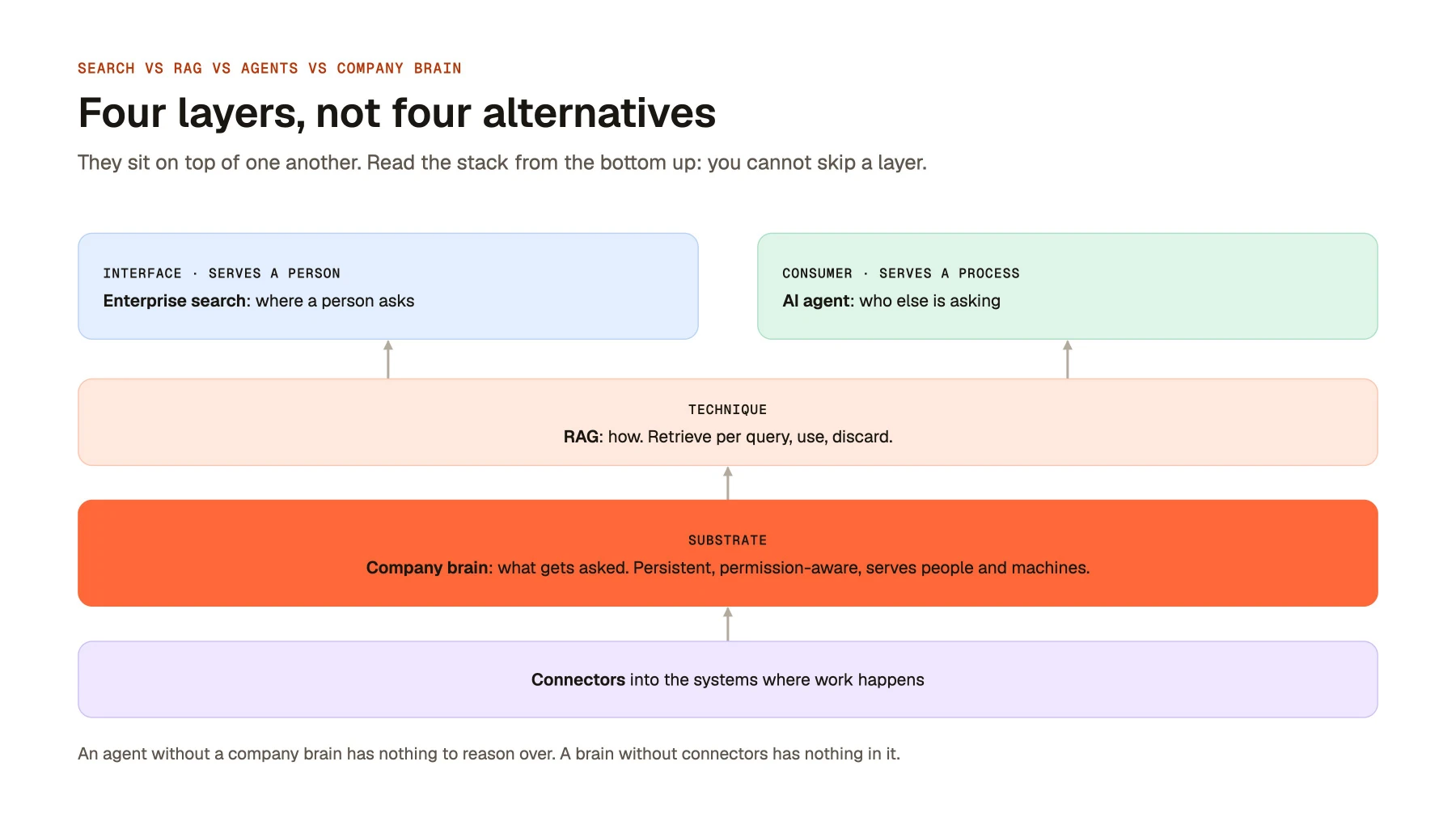
Enterprise search sits alongside the agent layer. It is a different consumer of the same underlying substrate, serving a person rather than a process.
Read the stack from the bottom up and the buying logic becomes clearer: You cannot skip a layer.
An agent without a company brain has nothing to reason over. A company brain without connectors has nothing in it. RAG without a permission layer beneath it can retrieve information people should not see.
Which Enterprise AI Layer Is Your Problem?
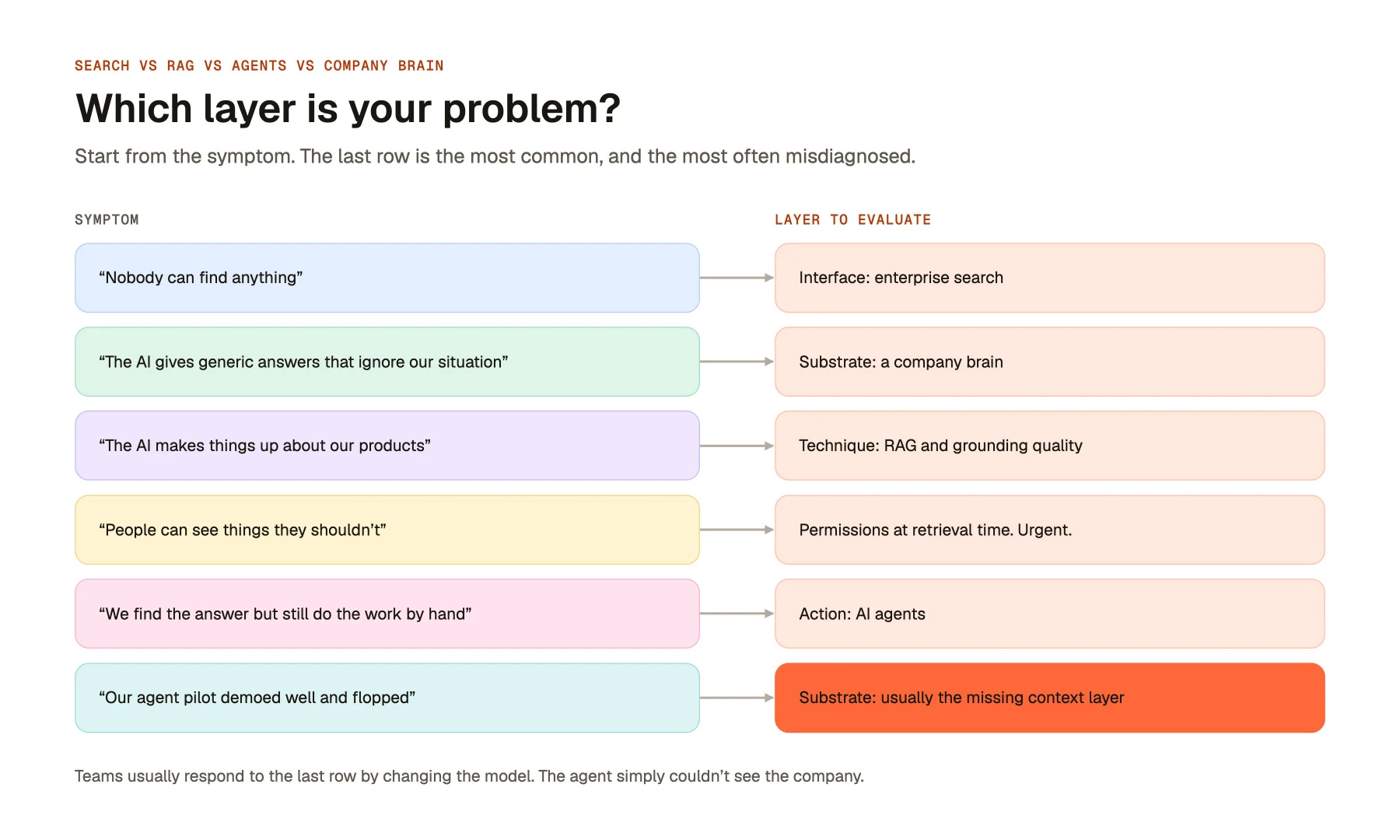
| Symptom | Layer | What to evaluate |
|---|---|---|
| "Nobody can find anything." | Interface | Enterprise search |
| "The AI gives generic answers that ignore our situation." | Substrate | Company brain / context layer |
| "The AI makes things up about our products." | Technique | RAG implementation and grounding quality |
| "People can see things they shouldn't." | Permissions | Access control at retrieval time — urgent |
| "We find the answer but still do the work manually." | Action | AI agents |
| "Our agent pilot demoed well and flopped." | Substrate | Usually the missing context layer |
The last row is the most common and the most consistently misdiagnosed.
Teams respond by changing the model or vendor when the actual deficiency is that the agent could not see the company.
Where Enterprise Search, RAG, and AI Agents Overlap
Being honest about the overlap matters because the taxonomy above is cleaner than the market itself.
Enterprise search vendors have added agents
Glean, Microsoft, and others now offer both retrieval and action. The category boundary is therefore a description of function, not necessarily of vendor.
Some products are a company brain without using the term
If a tool maintains a persistent, permission-aware index across systems and exposes it programmatically, it is effectively a company brain regardless of how it is marketed.
"Agent" is applied very loosely
Many things sold as agents are a single model call with a tool attached.
A useful test is:
Can it decide to do something you did not explicitly ask for, in service of the goal you gave it?
If not, it is probably an assistant rather than a true agent.
RAG is constantly sold as a product
When a vendor says "we do RAG," ask:
- What do you retrieve from?
- How does it stay current?
- How are permissions enforced?
Those answers tell you much more about the architecture than the RAG label itself.
Questions to Ask an Enterprise AI Vendor
Regardless of which category a vendor claims, ask these questions.
1. What does it retrieve from, and how does it stay current?
Are the systems connected live, or are documents periodically uploaded? Uploads go stale quickly.
2. How are permissions enforced?
Ask whether permissions are enforced at index time or retrieval time. Retrieval time, per user, is the answer that scales. A single service account becomes a liability once you move beyond one team.
3. Can other systems query it?
Or can only your interface access the underlying knowledge? This determines whether the platform can support agents and workflows later.
4. Does it persist context between sessions?
Or does every query start fresh?
5. If it acts, what can it do without approval?
And what gets logged? These questions reveal what you are actually buying far more quickly than a category label.
Where Libra Fits
Libra is the context layer.
It connects the tools your company already uses, enforces permissions on every retrieval, and serves context to people, workflows, and agents from the same index.
It runs locally, in your own AWS, Azure, or GCP account, or on Libra Cloud.
We never train on your data.
See how the layers fit together →
Keep reading
Frequently Asked Questions
No. Enterprise search is a product category serving a person. RAG is a technique for grounding a model's output. Many enterprise search products use RAG internally, but the two answer different questions: one describes what you are buying, while the other describes how it works.
There is overlap, and some vendors use the terms interchangeably. The meaningful distinction is that enterprise search serves a person through an interface, while a company brain can also serve agents and workflows programmatically from the same permissioned index. If a product cannot be queried by other software, it is search.
For any task requiring company-specific knowledge, effectively yes. Without one, an agent is limited to work that needs no organisational conte
Agentic RAG is a variant where the model decides what to retrieve, judges whether the results are sufficient, and retrieves again if necessary rather than relying on a single retrieval pass. It can improve accuracy on complex questions, but usually comes with higher latency and cost.
Some products cover several layers. Very few cover all of them well. Libra is one of them