Agentic AI Platforms: What They Are, How to Evaluate Them, and Where They Break
A complete guide to agentic AI platforms, how they differ from traditional AI, the use cases that work, evaluation criteria, deployment models, honest limitations, and how the main platforms compare.
10 min readby Prithvi

Most software sold as "agentic" in 2026 is an assistant with a longer context window. It answers well, summarises well, and stops at precisely the point where the work begins.
An agentic AI platform is the category that doesn't stop there. Given an objective, it plans a sequence of steps, calls real systems, inspects what came back, and adapts until the task is finished or it hits a limit it was told not to cross.
That difference sounds academic until you try to buy one. The two categories fail in completely different ways, get measured by completely different metrics, and require completely different governance — and most evaluation processes are built to test the wrong one. This guide covers what the category actually is, where it produces value, how to evaluate platforms, what the honest limitations are, and how the main options compare.
What an agentic AI platform is
An agentic AI platform is infrastructure for building, running and governing software agents that pursue goals rather than answer questions.
Four properties define the category:
Goal-directed behaviour. You specify an outcome, not a sequence. "Reconcile last month's exceptions and flag anything over threshold" rather than a flowchart of steps. The system decomposes the objective itself.
Tool use. The agent calls real systems — reads a CRM record, writes a ticket, queries a warehouse. This is mediated by function calling and connectors into the systems where work actually lives.
Statefulness. It remembers what it did three steps ago and what that produced. Without persistent company memory, each turn starts from zero and multi-step work is impossible.
A reasoning loop. Act, observe the result, decide whether it moved closer to the goal, adjust. This loop is what separates an agent from a scripted automation, and it's also the source of most of the risk.
How this differs from adjacent things
Not a chatbot. A chatbot maps input to a response. The loop closes with a human doing the work.
Not RPA. Robotic process automation follows a fixed script against a fixed interface. It's deterministic and brittle- change the screen and it breaks. An agent reasons about what to do next, which makes it adaptable and non-deterministic. Those are the same property viewed from two directions.
Not a workflow engine. A workflow engine executes a graph you drew. An agent decides the graph. Many real deployments combine both, because a fixed path is better wherever a fixed path exists.
Not a model. The model is one component. The platform is retrieval, permissions, tools, state, orchestration, evaluation and audit around it.
Agentic AI versus traditional AI
| Traditional AI / assistants | Agentic AI | |
|---|---|---|
| Input | A question or prompt | An objective |
| Planning | None — single turn | Decomposes into steps, re-plans on failure |
| Systems access | Reads context you paste or retrieve | Calls systems directly, often writes |
| State | Context window only | Persistent across steps and sessions |
| Output | Text for a human to act on | A completed change in a real system |
| Failure mode | A wrong answer | A wrong action |
| Measured by | Answer quality, satisfaction | Task completion, rework rate |
| Governance need | Content filtering | Permissions, approvals, audit |
That last row is the one buyers underestimate. A wrong answer is embarrassing. A wrong action is a corrupted record, a customer emailed in error, or a refund issued twice. The governance requirement isn't a compliance checkbox bolted on at the end — it's load-bearing architecture, and it's the single most common reason pilots never reach production.
Benefits: what actually improves
Vendor claims in this category are unusually inflated. Here is the honest version of where value comes from, in rough order of reliability.
Elimination of assembly work. The largest and most defensible gain. A great deal of knowledge work is gathering: pulling the account history, finding the prior decision, assembling the numbers. This work is high-volume, low-judgement, and spread across systems that don't talk to each other. Agents compress it. The judgement that follows is unchanged.
Compression of handoff latency. Work in companies spends most of its life waiting — in a queue, in someone's inbox, between two teams. An agent that prepares the next step the moment the previous one lands removes waiting time rather than working time. This often produces a larger cycle-time improvement than the task automation itself.
Consistency. An agent applies the same procedure at 4pm on a Friday as at 9am on a Monday. For processes where variance is the actual problem — triage, classification, routing, first-pass review — consistency is worth more than speed.
Coverage of the long tail. Tasks too infrequent to justify building an integration, but collectively significant. Agents reach these because the marginal cost of one more task shape is low.
Capacity reallocation rather than headcount reduction. The organisations that get durable value redeploy time into work that was previously not getting done. The ones that plan for headcount cuts tend to discover the remaining work was the hard part. We wrote about dividing work along this line in Human–AI Coworker Workflows.
A note on ROI figures: treat any vendor's percentage claim as marketing until you've run your own baseline. Productivity gains in this category are real but highly variable by process, and the published numbers are almost never measured the way your finance team would measure them.
Business use cases that work
Sorted by how reliably they produce value.
Knowledge retrieval and research
Finding and synthesising what the company already knows. Grounded in your own systems via RAG and semantic search, with citations back to source documents. Low risk because every claim is checkable, high value because the alternative is people re-deriving work that already exists. This is the tribal knowledge problem, and it's the most common successful first deployment.
Meeting capture and follow-through
Extracting decisions, commitments and owners from conversations, then tracking them. Depends on reliable diarization to attribute a commitment to the right person. See Meeting Assistant.
Inbox triage and drafting
Classifying what needs a decision versus what needs an acknowledgement, and drafting the mechanical replies.
Customer support resolution
Reading account state, determining what happened, and taking the action that fixes it. High value, high governance requirement.
Revenue operations
Pipeline hygiene, stale opportunity review, call follow-up, CRM enrichment. Mostly read-and-prepare work with a human approving writes.
Reporting and variance explanation
Answering "why did this number move" against governed data. The assembly is automated; the interpretation isn't.
Engineering and product triage
Reproducing bug reports, categorising incoming issues, drafting changelogs.
Marketing and content operations
Campaign brief assembly, performance summarisation, content repurposing. ‘
Evaluation criteria
Twelve questions. Most vendor pages answer the first three and avoid the rest, which is itself diagnostic.
Context and retrieval
1. What can it actually see? A platform grounded only in documents you upload is a different product from one connected to your live systems. Ask how many systems, and whether access is read-only.
2. Is there one context layer or many indexes? Fifty agents with fifty retrieval indexes produce fifty answers to the same question. A shared context graph is what makes a fleet coherent.
3. Does it cite sources? If answers can't be traced to source documents, you cannot audit them and you shouldn't deploy them.
Permissions and governance
4. Does it inherit source-system permissions, per user, per query? This is the hardest property to retrofit and the easiest to fake in a demo. See permissions-aware AI.
5. Is tenant isolation architectural or contractual? There's a real difference between "we don't mix your data" and "we can't."
6. Can approval be scoped per action class? Human in the loop should be configurable — autonomous for reads, approval-gated for writes, blocked for irreversible actions. All-or-nothing settings force you to choose between useless and dangerous.
7. Is there a tool-level audit trail? A chat log is not an audit trail. You need every tool call, its parameters, and its result.
Deployment
8. Cloud, VPC and self-hosted or cloud only? For many enterprises this ends the evaluation.
9. Where does inference happen? Data residency is about the model call, not just storage.
10. What is the retention position, contractually? Ask specifically about a zero data retention path.
Operations
11. How do you evaluate quality over time? Agent performance drifts. Without scheduled evaluation against real cases, you find out from a customer
12. Is pricing predictable? Token-metered pricing makes agentic workloads financially unpredictable, because an agent that retries costs more than one that succeeds. Per-team or per-workspace pricing is easier to forecast.
Risks and limitations
The parts vendors leave out.
Non-determinism. The same input can produce different action sequences. This is inherent to the reasoning loop, not a bug to be patched. It means testing is statistical, not exhaustive, and it means "it worked in the demo" carries less information than you'd like.
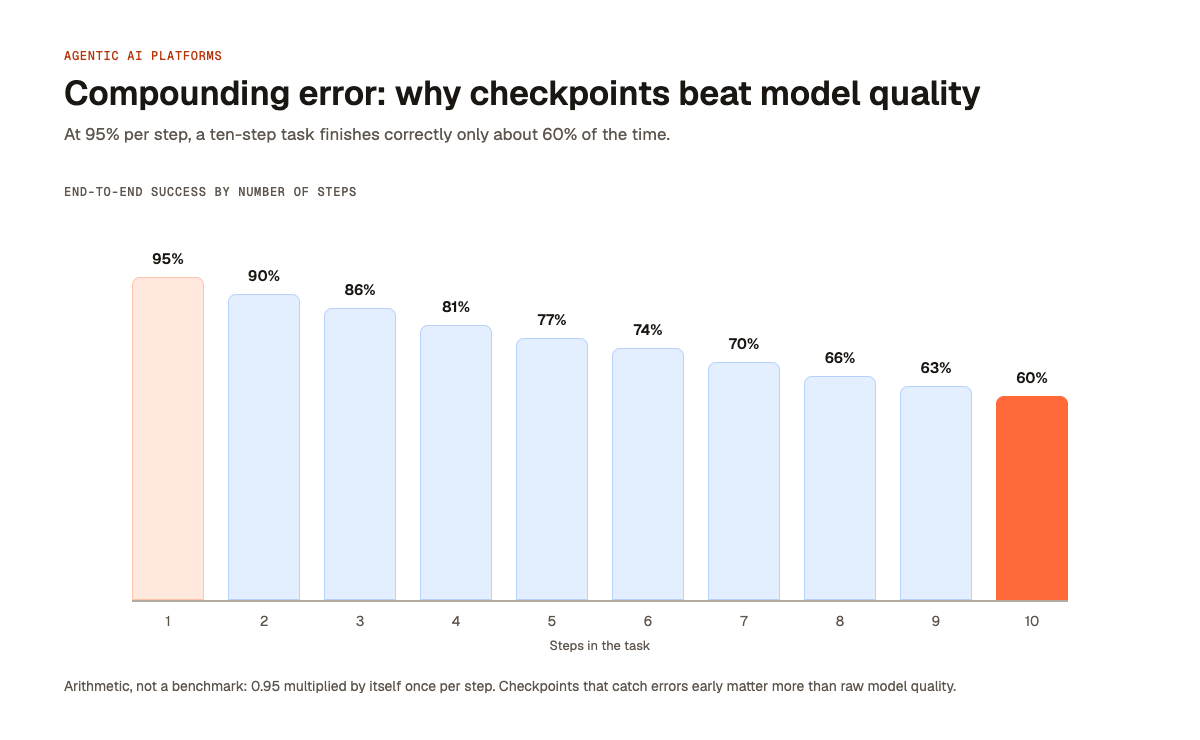
Compounding error. In a ten-step task, a 95% per-step success rate yields roughly 60% end-to-end. Multi-step reliability is the central engineering problem in this category, and it's why checkpoints matter more than raw model quality.
Confident wrongness. An agent that has misunderstood the goal pursues the wrong objective efficiently and without hesitation. There is no built-in signal of doubt.
Prompt injection and tool abuse. An agent that reads untrusted content — an inbound email, a web page, a customer ticket — and also has write access is an attack surface. Content it reads can contain instructions. See AI Agent Security.
Permission escalation by aggregation. An agent with access to several systems can infer things no single system would reveal. Field-level access control doesn't protect against inference across sources.
Over-automation. Teams automate the measurable part and leave humans a residue of exceptions with no context. Job quality degrades and error rates rise. This is a design failure, not a technology limit, but it's common.
Integration debt. Every connector is a dependency. APIs change, permissions models differ, and rate limits bite. The honest cost of a platform includes maintaining these.
Evaluation cost. Doing this properly is ongoing work, not a launch task. Budget for it or accept drift.
Integration and deployment
Connectors
Two questions that matter more than connector count: does it write, or only read? And does it preserve permissions on the way through? A connector that reads as a service account rather than as the user is a permission bypass with a nice logo. Many agentic platforms now standardise tool access via MCP
Deployment models
| Model | Where inference runs | Where data sits | Typical fit |
|---|---|---|---|
| Vendor cloud | Vendor infrastructure | Vendor infrastructure | Fastest start; lower-sensitivity internal use |
| VPC / BYOC | Your cloud account | Your cloud account | Most regulated enterprise deployments |
| Self-hosted | Your infrastructure | Your infrastructure | Strictest residency and control requirements |
VPC is the pragmatic middle for most enterprises — it satisfies residency and control requirements without the operational burden of self-hosting. See BYOC Enterprise AI Deployment.
Identity and rollout
The agent must act as a user, inheriting that user's rights — which requires integration with your identity provider and an identity graph mapping identities across systems. A workable rollout sequence: read-only retrieval for one team, then draft-and-approve, then scoped autonomous actions, then expansion. Teams that skip to autonomous actions usually end up rebuilding the permission model under pressure.
How the platforms compare
Platforms in this category cluster into five archetypes. Which archetype fits matters more than feature-by-feature comparison.
1. Developer frameworks — LangChain/LangGraph, CrewAI, AutoGen. Maximum control, minimum scaffolding. You build retrieval, permissions, audit and evaluation yourself. Right when agents are your product; expensive when they're internal tooling.
2. Suite-native agents — Microsoft Copilot Studio, Salesforce Agentforce, Google's agent tooling. Deepest integration with that vendor's own stack, weakest outside it. Often the default choice when a company is already committed to one suite.
3. Workflow-first automation — Gumloop, n8n, Zapier's agent features. Strong on connectors and visual building, lighter on enterprise permission models and evaluation.
4. Vertical agents — point solutions for support, SDR work or coding. Fastest time to value in their lane, no leverage outside it.
5. Work platforms — Glean, Dust, Kore.ai, Libra. Company-wide context layer with agents on top, built around enterprise permissions and deployment.
A shortcut that holds up: if agents are a feature of your product, buy a framework. If agents are how your company works, buy a platform with a context layer and a permission model, because you will otherwise build both yourself — twice.
Where Libra fits
Libra WorkBase is a work platform.
One context layer across company systems, with Knowledge Base, Meeting Assistant, Email Assistant, Business Intelligence, Agents and Workflows on top, connected through Integrations.
Permissions inherit from source systems per user. It deploys to cloud, VPC or self-hosted, and is sold by team rather than per seat. Security and deployment detail is on the Enterprise page.
Frequently Asked Questions
In practice, yes. "Agentic" emphasises autonomy and planning; "agent platform" emphasises building and running. Buyers use them interchangeably.
No. One bounded task is cheaper to solve with a point tool. The platform argument begins when several use cases need the same company context and the same permission model — otherwise you build both repeatedly.
Read-only retrieval is quick. Autonomous action takes longer, and the time goes into permissions, evaluation and approval design rather than into the model. Treat any "live in a week" claim as describing a demo environment.
RPA follows a fixed script and breaks when the interface changes. An agent reasons about what to do next, which makes it adaptable and non-deterministic. Many deployments use both — fixed paths where they exist, agents where they don't.
Permission inheritance from source systems, an approval gate on every write, and a tool-level audit trail. Everything else can follow.