What Is Agentic Process Automation? How AI Agents Change Business Workflows
Learn what agentic process automation is, how AI agents differ from traditional automation, and where enterprises can use agentic workflows.
7 min readby Prithvi

Traditional automation follows a predefined process. If this happens, do that. If the data matches this condition, send that email.
If the ticket is marked urgent, route it to this queue. It works well when the world behaves exactly as expected.
Business processes rarely do.
A customer request might arrive as an email instead of a form. A document might be missing information. A ticket might require research before it can be routed. A meeting might introduce a new requirement that wasn't part of the original workflow.
That's where agentic process automation comes in.
Instead of programming every possible path in advance, an AI agent can interpret the situation, decide what steps are required, use the tools available to it, and continue working until it reaches an outcome or a boundary that requires human input.
What Is Agentic Process Automation?
Agentic process automation is a form of business process automation where an AI agent decides and executes steps dynamically rather than following only a fixed sequence of predefined rules.
Traditional automation might look like:
Trigger → Step 1 → Step 2 → Step 3 → Finish
Agentic automation can look more like:
Goal → Understand → Decide → Act → Evaluate → Continue
The difference is important. An agent isn't simply executing instructions.
It can determine which instructions are relevant to the situation in front of it.
Traditional Automation vs. Agentic Automation
| Traditional Automation | Agentic Process Automation |
|---|---|
| Fixed workflow | Dynamic workflow |
| Predefined rules | Context-aware decisions |
| Predictable inputs | Variable inputs |
| Developer-defined paths | AI determines next steps |
| Stops when conditions break | Can adapt to new situations |
| Best for structured processes | Best for knowledge-heavy work |
This doesn't mean agentic automation replaces traditional automation.
It means there is now another tool for processes that are too variable to encode entirely as rules.
What Is an AI Agent?
An AI agent is software that can take a goal, determine the steps required, use available tools, and carry out the task.
For example: “Review new enterprise support tickets and prepare the escalations that need engineering.”
An agent might:
- Find newly created tickets
- Read the ticket
- Look up the customer's account
- Search relevant documentation
- Check whether the issue is already known
- Identify severity
- Gather technical context
- Prepare an escalation
- Route it to the correct team
- Wait for approval before sending anything externally
The important part is that the agent can work through the problem, rather than requiring a person to specify every step.
When Should You Use Agentic Process Automation?
Agentic automation works best for processes that are:
Multi-step They require several actions across systems.
Context-heavyThe next step depends on information that isn't always structured.
Variable Inputs can arrive in different formats or require different paths.
Repetitive The organisation performs the process frequently.
Knowledge-intensive The process requires understanding policies, documents, previous decisions, or company context.
Where Does Agentic Automation Fit?
Some business processes are already highly structured. Payroll calculations are a good example.
A traditional automated workflow may be the right solution. Other processes have far more variation.
Consider customer support.
A ticket could involve:
- A product bug
- An account issue
- A billing question
- A configuration problem
- A new feature request
A rigid workflow may need dozens of branches to handle these cases. An agent can interpret the issue and determine which path makes sense.
Agentic Workflows
An agentic workflow is a process where an AI agent dynamically determines and executes some or all of the steps required to reach an outcome.
For example:
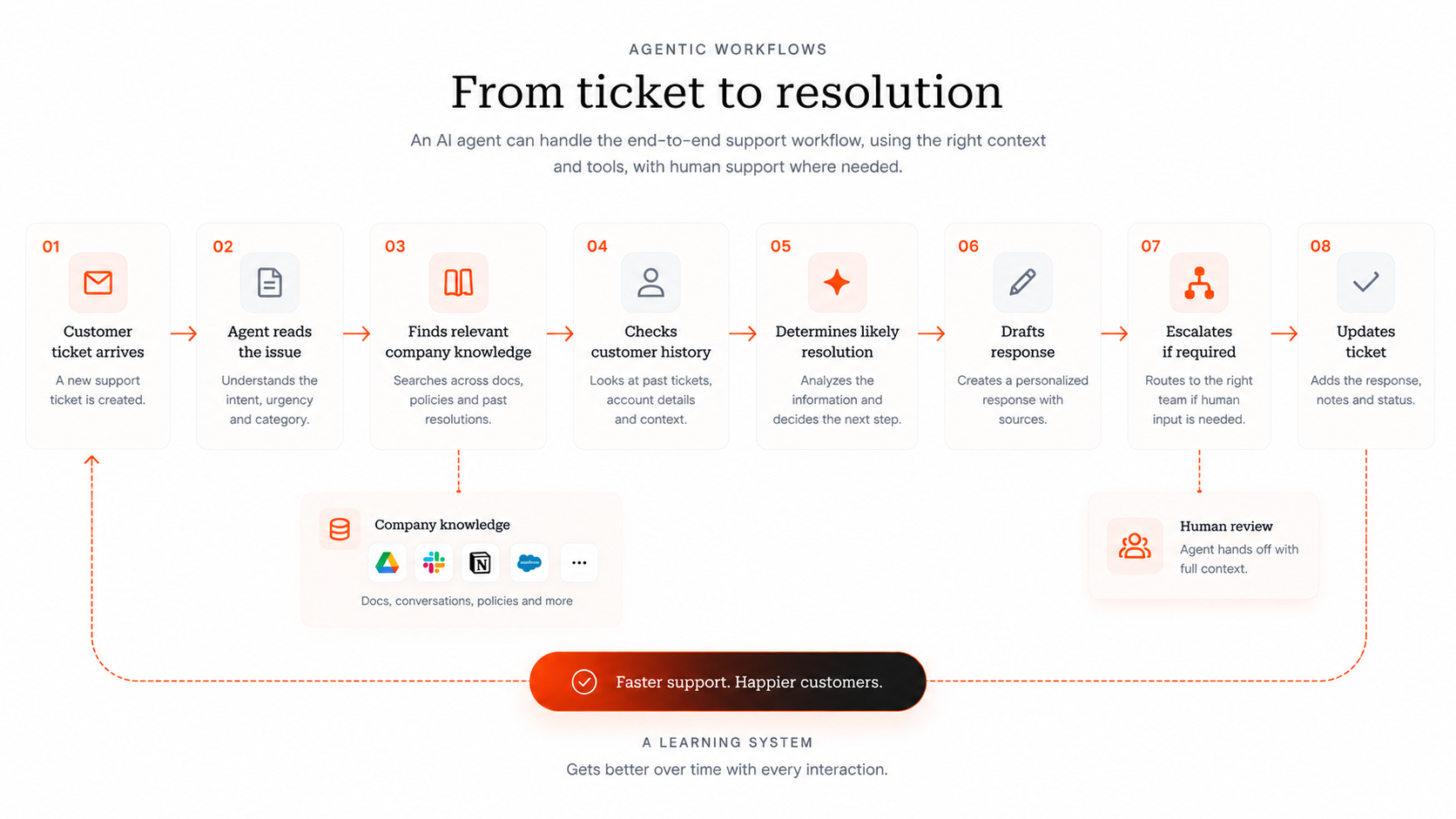
The workflow doesn't have to be identical for every ticket.
The agent determines what to do based on the situation.
What Is Agentic Orchestration?
Agentic orchestration is the coordination of multiple agents, tools, and steps within a larger task.
Imagine a product-feedback workflow:
The orchestrator coordinates the work and determines when each stage should happen.
Agentic Automation Needs Context
An agent without context is just making educated guesses.
Enterprise processes depend on information such as:
- Company policies
- Customer history
- Internal documentation
- Previous decisions
- System records
- Conversations
- Current business data
This is why agentic process automation and knowledge management increasingly overlap.
The agent needs somewhere to retrieve the information required to make a decision.
Agentic Automation Also Needs Permissions
Giving an AI the ability to reason is one thing.
Giving it access to production systems is another.
An enterprise agent may need access to:
- CRM
- Support systems
- Project tools
- Documents
- Databases
That creates a second requirement:
The agent needs to know what it can do. An effective agent platform therefore needs controls for:
Tool Access Which systems can the agent use?
Action Permissions What can it actually change?
Approval: Where should a human review the action?
Auditability What did the agent do?
BoundariesWhen should the agent stop?
Without those controls, autonomy becomes difficult to trust.
No-Code AI Agent Builders
As agentic automation becomes more common, organisations increasingly want to build agents without programming every workflow manually.
A no-code AI agent builder typically lets users define:
- The goal
- Instructions
- Available tools
- Knowledge sources
- Approval points
- Triggers
This shifts some automation work from developers to the people who understand the business process best.
A support leader can define a ticket workflow. A sales leader can define a lead-enrichment process. An operations team can define a recurring reporting workflow.
The technical layer still matters, but the interface for defining the work becomes much more accessible.
Agentic Process Automation for Enterprises
Enterprise adoption introduces a few additional requirements.
Security Agents may interact with sensitive systems and information.
Governance Organisations need to know which agents exist, what they can access, and what they can do.
Reliability: A workflow cannot simply work in a demo. It needs predictable behaviour across real-world inputs.
Observability Teams need visibility into what happened during an Agent run.
Human Control Not every action should be autonomous.
The best systems make it easy to decide where the agent acts and where it asks.
A Practical Example
Consider a renewal workflow.
A traditional process might be:
- CSM receives renewal notification
- Searches account information
- Checks usage
- Reviews support tickets
- Reviews recent emails
- Prepares renewal notes
- Updates CRM
- Drafts customer email
An agentic process could take the goal: “Prepare the account for renewal.”
The agent determines that it needs:
- CRM information
- Recent customer conversations
- Support history
- Usage data
- Previous meeting notes
It gathers the information, prepares a renewal brief, updates the relevant fields, and drafts the follow-up.
A human can then review the actions that matter before they're committed.
The process becomes goal-driven instead of task-driven.
Where WorkBase Fits
Libra WorkBase is designed for this kind of company-level automation.
Instead of creating isolated AI experiments, teams can build workflows around the systems and information they already use.
A workflow can:
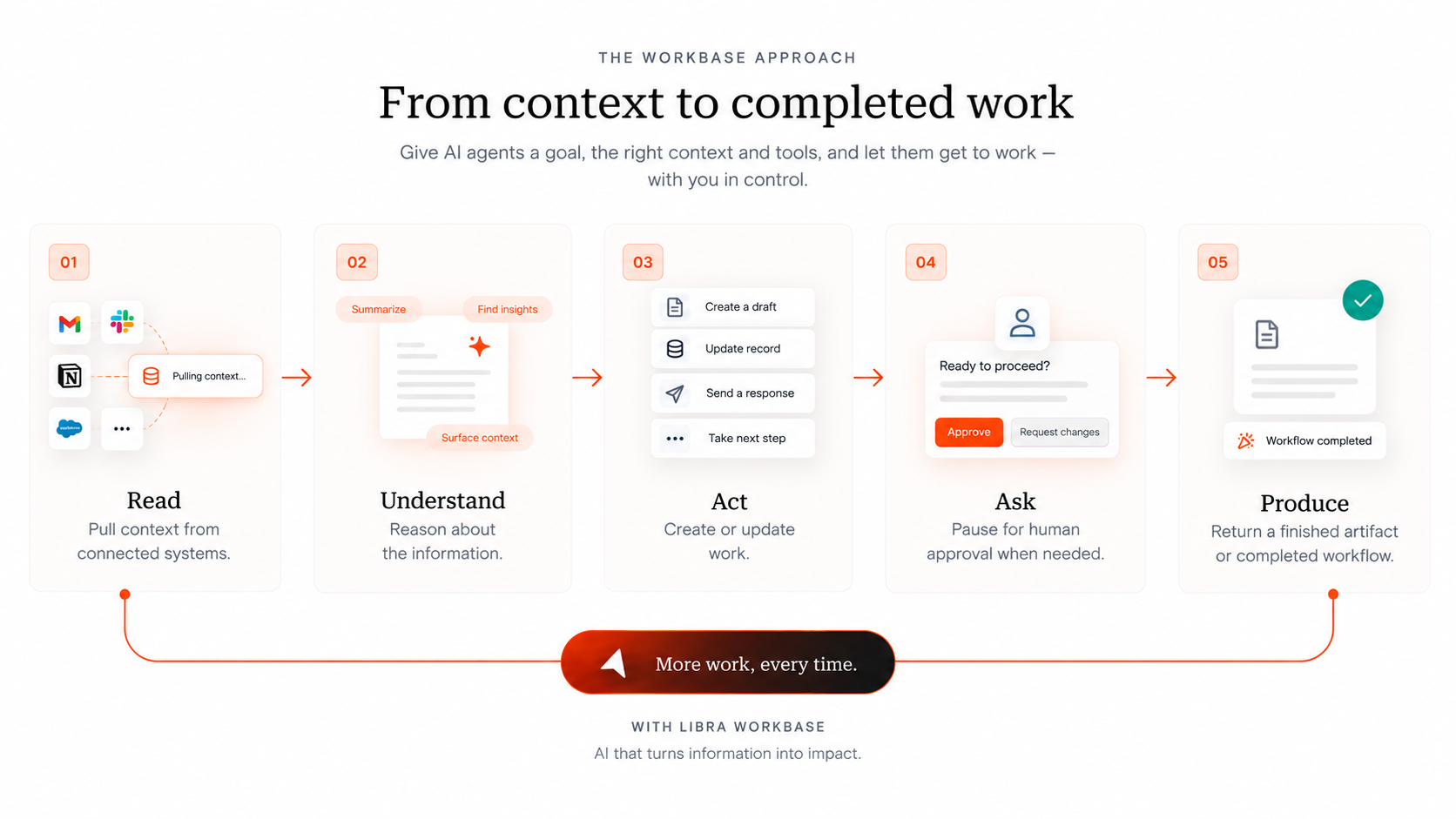
Agents can then handle more dynamic, multi-step parts of the process.
The result is not “AI replacing the workflow.”
It's a workflow where AI can determine more of the work required to reach the outcome.
When Not to Use Agentic Automation
Agentic process automation isn't always the right answer.
A traditional workflow may be better when:
- The process is completely deterministic
- Every input is structured
- Every step is already known
- There are strict calculations or compliance rules
- The cost of variation is extremely high
The goal isn't to replace deterministic automation with AI everywhere.
It's to use agents where judgement and adaptation are part of the work.
What's Next for Business Automation?
The first generation of automation focused on making predefined processes faster.
The next generation is increasingly about giving software a goal and letting it figure out the path.
That changes the unit of automation from: “Run these steps.”
To: “Get this done.”
That shift is the real promise of agentic process automation. And for enterprises, the winning systems won't simply be the most autonomous.
They'll be the ones that combine context, execution, permissions, and human control.